Almost every medical device that arrives at a pharmacy, an orthopaedic supplier or a distribution warehouse today carries a long barcode on the label, sometimes a square of dots, and underneath a string of numbers in brackets. That is the UDI, the unique device identifier required by Regulation (EU) 2017/745. It may look like the manufacturer's business, but the distributor has three specific obligations around it, and one of them is the kind inspectors ask about.
This article is about reading it: what each part means, which part you need to keep and which products should already carry it.

What the UDI is and why it exists
Before the MDR, each manufacturer identified its products however it liked. The same model could have one reference on the box, another on the invoice and another on the delivery note, and in a recall, tracking down the affected units was a job of phone calls and spreadsheets.
The UDI solves that with a unique code for each model and pack, issued by an entity designated by the Commission (GS1 is the most common; HIBCC, ICCBBA and IFA also exist), registered in the European EUDAMED database and printed on the product label and on every level of packaging. With it, anyone in the chain, from the manufacturer to the pharmacy, knows exactly which product and which batch they are talking about.
The two halves of the code
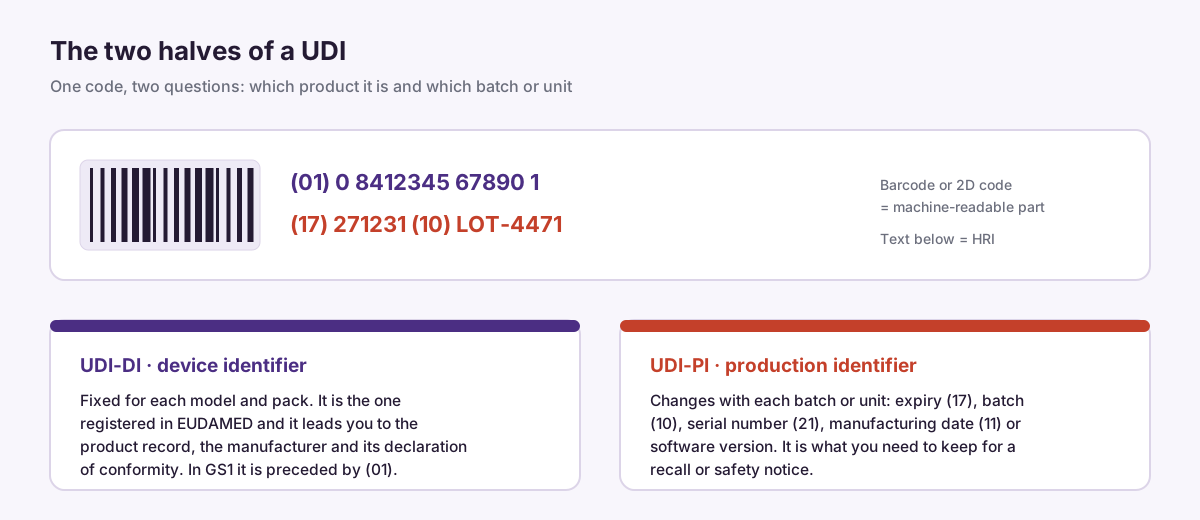
A UDI always has two parts, and it is worth keeping them apart in your head because they do different jobs:
UDI-DI (device identifier). The fixed part. It identifies the model and the specific pack (a box of ten has a different UDI-DI from a box of a hundred). It is the one registered in EUDAMED and it leads you to the manufacturer, its authorised representative if there is one, and the product documentation. In the GS1 system it is preceded by (01) and has fourteen digits.
UDI-PI (production identifier). The variable part. It depends on how the manufacturer controls production and can include the expiry date (17), the batch number (10), the serial number (21), the manufacturing date (11) or, for software, the version. It is what you need when a safety notice arrives: "batch 4471 of product X".
All of this appears on the label in two forms at once: machine-readable (linear barcode, DataMatrix or RFID) and human-readable, the text underneath. If the scanner fails, the label can still be read.
The UDI-DI is not the same as the Basic UDI-DI. That one is a grouping code that appears on the declaration of conformity and on certificates, not on the label. If the code on the EU declaration of conformity doesn't match the one on the box, that may be why, and it is not an error.

Which products should already carry it
The MDR phased in the obligation by risk class, and for labels every deadline has now passed:
- Implantables and class III: since May 2021.
- Class IIa and IIb: since May 2023.
- Class I: since May 2025.
What is still being phased in is direct marking on the device itself for reusable devices (the UDI engraved on the instrument, not just printed on the box), which comes two years after each of those dates: reusable class I devices will need it from May 2027.
Watch out for "legacy" devices: those still on the market under a certificate from the old directives, thanks to the MDR transition extension, don't have to carry a UDI until they move to the Regulation. It is the most common exception you will see at the counter, and it is not a defect.
What the distributor has to do
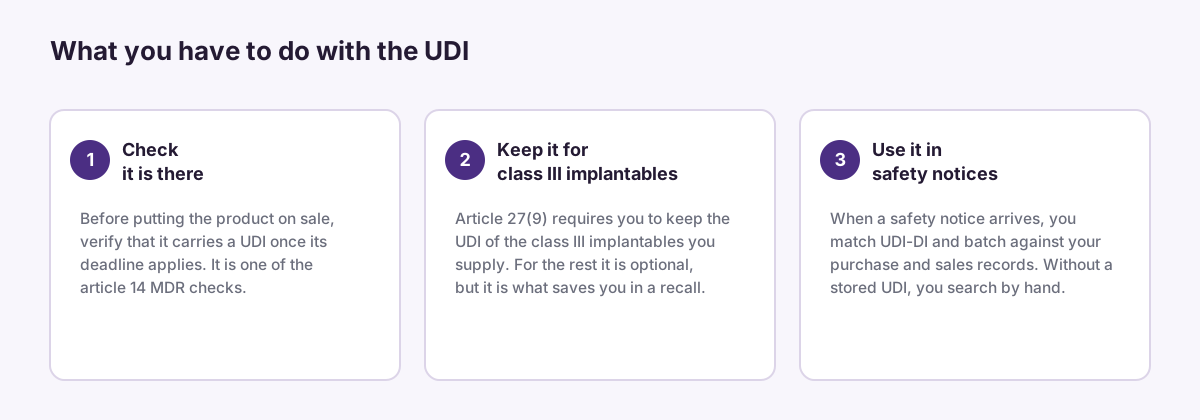
Article 14 of the MDR requires distributors, before making a device available, to check that it carries the CE marking, that an EU declaration of conformity exists, that the manufacturer's information is in the required language and that a UDI has been assigned where applicable. We have already covered what to check in the CE marking; the UDI is another point on that list.
The second obligation is more specific and it is the one inspectors ask about: article 27(9) requires economic operators to store and keep the UDI of the class III implantable devices they supply. If you dispense or distribute that type of product, you need to be able to say which UDI-DI and which batch or serial number each unit that left your premises had.
For other products, keeping the UDI is not mandatory for the distributor, but it is what turns a safety notice from the national competent authority into twenty minutes' work instead of an afternoon. If your management software already scans the barcode on receipt and on sale, most of the work is done: you only need to make sure it stores the UDI-PI and not just the item code.
Three quick checks at the counter
- Does the (01) on the outer box match the one on the unit? Different packs should have different UDI-DIs, and the same pack should have the same one.
- Does the expiry date in the text match the (17)? Dates in the code are in YYMMDD format; the printed text usually follows the familiar format. A mismatch is grounds for a return.
- Does the UDI-DI appear in EUDAMED? The public search of the database is free. If it isn't there and the product is already past its deadline, ask your supplier for an explanation before selling any more.
If you want this organised without relying on anyone's memory, that is exactly what the Dossalis suppliers and products module does: it stores the UDI, the declaration and the certificate for each item and warns you about what is missing before an inspector asks.